8 October 2026Interviews
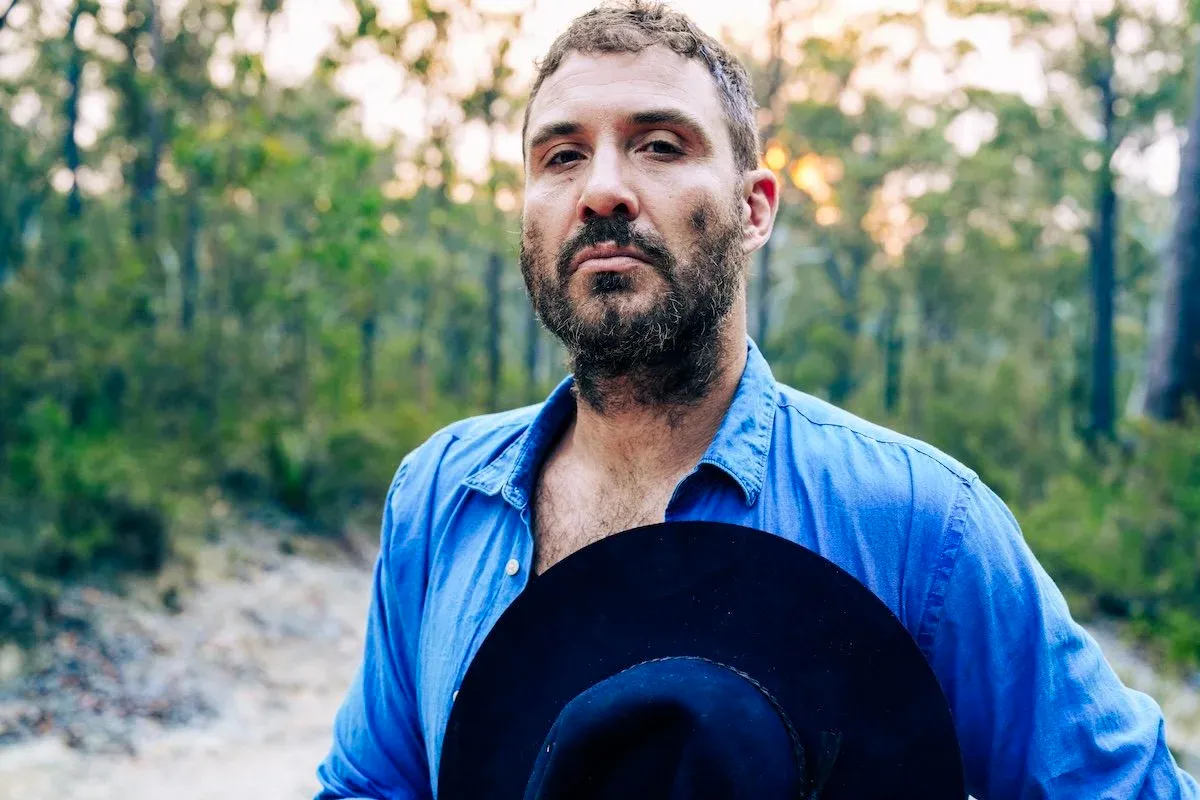
There are few modern Australian wordsmiths as compelling as William Crighton. The ARIA-winning singer-songwriter peels back the layers of society through his visceral lyrics that paint a realistic and relatable picture of Australian culture. Ahead of the release of his fourth record, Colonial Drift, Crighton spoke with The Note about working with the late Rob Hirst, writing music with his wife Julieanne and his connection to Australia.
Interview Tobias Handke // Image Julieanne Crighton
You’ve been described as a pioneer of “Bush Psych”. What are your thoughts on this label, and how would you describe your music?
I’m influenced by a lot of styles — country, blues, rock, folk, psychedelic, etc. I’m also influenced heavily by the natural soundscapes and stories around me. The music we (Julieanne, the band and I) create aims to sound like where we are from. The rivers, the dust, the storms, the wildlife at dusk, the strange energy that exists in remote places — it all seeps in.
“Bush Psych” makes sense to me. It’s connection and experimentation shaped by the land and by history. It’s always evolving, always changing.
You’ve been making music for over 25 years and have spent a considerable amount of time living and performing across America and China. How did that experience shape you as both a person and an artist?
Probably longer than 25 years — I started singing when I was about four or five and haven’t really stopped. It took me a while to work out who I was as an artist and what I wanted to sing about.
Living and travelling through the US and China in my early 20s opened my eyes to different ways of life, different cultures and of course a lot of music. You realise pretty quickly that people everywhere are dealing with similar things — love, struggle, identity, hope. It widened my perspective.
If anything, it deepened my appreciation for home. You leave and you see things clearly. You come back and you understand what’s unique about this place.
What was the biggest lesson you took from that time in your life?
There are stories everywhere. If you listen closely enough — whether it’s in a city in China, a small town in America or out bush here — there’s always something unfolding. That idea has stayed with me.
Colonial Drift is your fourth studio album and first since 2022’s ARIA Award-winning Water and Dust. What impact did winning the ARIA have on your career?
Winning the ARIA for Water and Dust was genuinely surprising and very humbling. To receive that kind of recognition from peers in the industry felt significant. Practically, it helped more people hear the record, which is always a good thing. But creatively, you can’t think about awards too much. The work has to stay honest. If you start chasing outcomes, you lose the thread.
Colonial Drift was recorded at your home studio and The Grove Studios with Damian Charles, with whom you have worked previously. How did your relationship come about, and what does he offer as a producer?
Damo recorded the band at The Grove and also worked with us at Oceanic. The music we tracked at home was produced by Christopher Dale, Luke Davison and me.
Damien Charles is incredibly hardworking and creative. I first met him about ten years ago when he was doing live sound for The Basics. We just clicked. He’s also our live engineer, so he understands the dimensions we’re trying to capture — that sense of scale, space and dynamics. He’s not overbearing. He knows when to speak and when to let things breathe, which is a great quality.
READ MORE: sleepazoid Talk ‘New Age’ and Creating Their Own World
You also collaborated with your wife, Julieanne, who helped with the writing of Colonial Drift. What is that dynamic like between you, and how do you approach writing together?
It’s always been very natural between us. On Colonial Drift, we really worked as “one brain”.
Sometimes I’ll bring in a nearly finished song, and she’ll help trim the fat and add a line or two that ends up being my favourite. Other times, like on ‘WarZone’, Rob Hirst and I had a chorus, and Jules essentially wrote the rest of the lyrics. She’s an incredible lyricist. She’s also a strong editor — and that’s just as important.
Speaking of the late, great Rob Hirst, he was another major part of the creation of Colonial Drift. It must have been a privilege to not only work with him but also get to know him on a personal level. What can you tell us about that experience?
Working with Rob Hirst was a huge honour. He had an incredible melodic sense and could identify excess in a song immediately. No fat. Everything served the song.
On ‘WarZone’, he challenged us to rebuild parts of it because we’d drifted from the original intent. He was direct but always positive. Under his guidance, we stripped it back and rebuilt it stronger.
Even beyond the tracks he directly worked on, his spirit influenced the whole album. We received news of his passing an hour before filming the video for ‘WarZone’. His presence is all over that song and always will be in my work.
The songs on Colonial Drift are incredibly vivid and really capture modern Australiana, both the good and the bad. What was your biggest inspiration when writing this record?
The people and places around us. The strange time we’re living in. The tension between love of country and the realities of history. The beauty and the chaos existing side by side.
I’ve been increasingly drawn to capturing soundscapes — radio snippets, ambient noise, environmental recordings — because sometimes they tell parts of the story the music alone can’t.
‘Warzone’ is one of my favourite tracks on the album. It has a simmering undercurrent of danger and unpredictability. What can you tell us about the making and meaning behind this song?
It reflects the emotional and social turbulence we’re living through. There’s personal tension in it, but also something broader — a sense of pressure building. Musically, it evolved a lot. Rebuilding it with Rob’s guidance gave it that push and pull. That unpredictability you’re hearing is partly arrangement, partly production — and partly just the times.
Another standout is the piano ballad ‘Australia’ – a heartfelt ode to the country you love. What is it about our nation that strikes a nerve with you?
Julieanne and I wrote that one together. I’d been circling the idea for a while, but couldn’t land it until one afternoon when it all clicked. It’s about the things that transcend “nationhood” — the land itself. Wild oceans, snowy mountains, deserts and river plains. The emotional spectrum we feel for this place is as vast as the landscape. Some people try to claim ownership of land, but ultimately, we belong to it. Not the other way around.
READ MORE: Kylie Auldist: Twenty Sixteen
Your lyrics often depict Australian landscapes and environments in such graphic detail. What is your connection to the land? What does it mean to you?
Everything comes from the land — every instrument, every building, every piece of technology. We’re not separate from it. For me, going bush forces you to slow down, to listen, to process. That space directly influences how I write. The soundscape around me always finds its way into the music somehow.
You are taking Colonial Drift on the road across Australia and New Zealand in April and May. What is your favourite thing about performing live?
Watching the songs take on new life every time they’re played. If I don’t get in the way, they evolve. And the connection with people who come along for the ride — that shared moment is powerful. That’s what makes it worth it.
Before touring Australia, you are supporting The Dead South in Europe. How do you find playing to international audiences? Is there a difference between here and there
Supporting The Dead South in Europe will be great. They are our mates and a really great band. For me, International audiences might not catch every lyrical reference, but they connect with feeling and energy just the same. There are differences culturally, sure — but fundamentally, people respond to authenticity. If you’re honest in what you’re putting forward, it translates.
Last one, what do you hope people take away from listening to Colonial Drift?
I hope they feel something real. Whether that’s pride, discomfort, love, urgency or gratitude — I hope it sparks reflection. The record is a snapshot of where we are and who we are at this moment. If it encourages people to listen more deeply — to the land, to each other, to the strange times we’re living in — then it’s done its job.
Catch William Crighton performing at Lion Arts Factory on Friday 17 April. Tickets on sale now at moshtix.com.au. Colonial Drift is out March 20 via ABC Music. Pre-order/pre-save here.
Get the best of The Note in your inbox.