15 October 2026Interviews

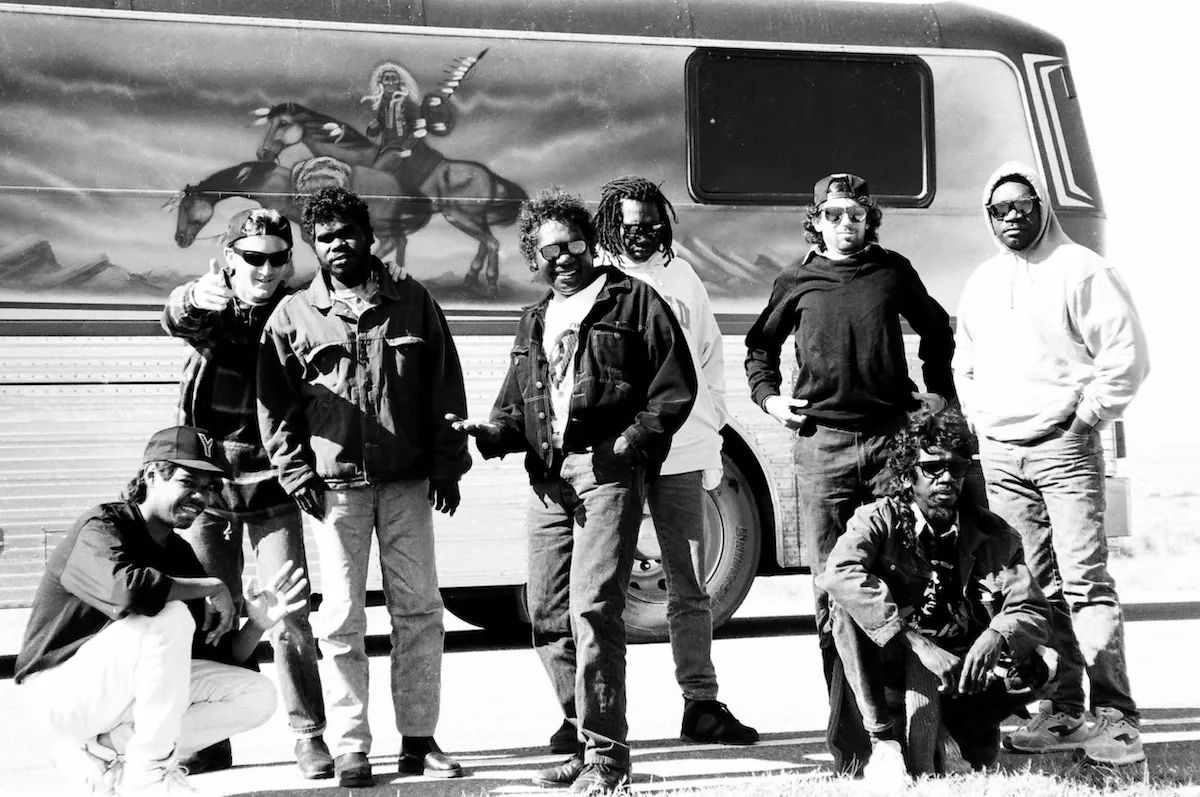
Returning to perform at WOMADelaide for the first time since 1993, Yothu Yindi’s Witiyana Marika spoke with The Note about the band’s iconic song ‘Treaty’, working with Baker Boy and “blowing the roof off” the Bondi Pavilion.
Words Tobias Handke // Image Alan James
This year marks the 35th anniversary of Yothu Yindi’s ‘Treaty’, arguably one of the most important protest songs in Australian music history. Taken from the band’s 1991 sophomore album Tribal Voice, which reached #4 on the ARIA Album Chart, ‘Treaty’ is an upbeat merger of traditional Aboriginal music and contemporary rock with lyrics highlighting the lack of progress made since the release of the 1988 Barunga Statement.
For those playing at home, the Barunga Statement was presented to then Prime Minister Bob Hawke at the Aboriginal Australian and Torres Strait Islander cultural event known as the Barunga Festival, which has been running for more than 35 years. As explained by the Parliament of Australia, the Barunga Statement “calls upon the Australian Government for a national Treaty recognising the human rights, freedoms, and sovereignty of Aboriginal and Torres Strait Islander peoples.”
Created by Wenten Rubuntja (Central Land Council) and Galarrwuy Yunupingu (Northern Land Council), who was the brother of Yothu Yindi’s Mandawuy Yunupingu, the statement heavily inspired ‘Treaty’.
Written by Yothu Yindi with contributions from acclaimed Australian songwriters Paul Kelly and Peter Garrett, the message behind the song is as relevant today as when the song was first released, with ‘Treaty’ a powerful reminder of the challenges faced by Indigenous Australians. But it’s also a song preaching harmony and togetherness made “for all people,” explains Yothu Yindi founding member Witiyana Marika.
“[‘Treaty’] is dedicated to everyone right across this planet, Indigenous people and non-Indigenous people,” Witiyana says over the phone from Melbourne. “We are people. Different colours of people, but we understand each other. We have one blood but different colours, but we are people.”
Talking about his early years, Witiyana points to his father as being a “strong influence” on his musical journey, along with teacher and artist Mandawuy, who handpicked a teenage Witiyana to be part of a Yolngu band that also included Milkayngu Mununggurr and Gurrumul Yunupingu. “He was watching me,” Witiyana says with a laugh as he discusses his relationship with Mandawuy. “[He told me], ‘I’m going to start a band and lead our people into another world. We're going to make a movement and make our stand.”
That movement arrived a couple of years later in 1986 in the form of Yothu Yindi – an amalgamation of the white rock group Swamp Jockeys (Todd Williams, Michael Wyatt, Cal Williams, Stuart Kellaway, Andrew Bellety) and the Yolngu folk group consisting of Mandawuy, Witiyana and Milkayngu. Witiyana speaks of first performing on “local stages, then national stages” as Yothu Yindi’s popularity grew organically. He points to the group’s show at the Bondi Pavilion in Sydney in early 1988 as a pivotal moment where Yothu Yindi “blew the roof off” the venue.
READ MORE: James Reyne On Moving Forward and Not Looking Back
That performance was part of a fundraising event for the Bicentennial Protest Group. In response to the celebrations organised to celebrate 200 years since the British First Fleet arrived in Botany Bay, First Nations leader Rev. Charles Harris planned the Long March for Justice, Freedom and Hope. Thousands of Aboriginal and Torres Strait Islander people made the trek to Sydney to march through the streets to shine a spotlight on the struggle of First Nations people and call for unity.
The mini-festival was organised to raise money for the march and featured performances from a host of inspiring Australian artists, including Archie Roch and Ruby Hunter, Crowded House, Paul Kelly and Midnight Oil, whose vocalist, Peter Garrett, was so enamoured by Yothu Yindi that he asked them to accompany the Oils on tour across the USA and Canada.
The tour opened Witiyana to the wider world and helped increase Yothu Yindi’s popularity. So much so that as soon as they returned to Australia, the band signed a deal with Mushroom Records and released their debut album, Homeland Movement. The album reached #54 on the ARIA Album Chart, but it was their follow-up record, 1991’s Tribal Voice, that shot them to worldwide superstardom. Off the back of the remixed version of ‘Treaty’, the album climbed to #4 on the ARIA Album Chart and spawned the charting hits ‘Tribal Voice’ and ‘Djäpana (Sunset Dreaming) Remix’.
The success of their early records in the ‘90s gave Yothu Yindi a platform to spread their message of unity through song and dance. Now in his sixties, Witiyana continues to find enjoyment not only from playing live but also from mentoring up-and-coming Aboriginal artists. “I like performing with the young people,” he explains. “They want an elder to represent them and show them the path, how to live and unite people, both non-Indigenous and indigenous.” He specifically mentions Baker Boy, who enlisted Yothu Yindi for a new version of ‘Treaty’ that was released in 2018, calling it a “dancefloor hit” that he was “very happy” with. “It’s a good way to keep the powerful message of unity going,” Witiyana says of the updated version.
Along with celebrating the 35th anniversary of ‘Treaty’, this year marks Yothu Yindi’s return to WOMADelaide for the first time since the inaugural festival in 1993, which was headlined by founder Peter Gabriel, who Witiyana is quick to point out caught Yothu Yindi’s iconic performance at the festival. “Peter Gabriel was there. He understands the power of the lyrics,” Witiyana says. “He said, ‘This is Yothu Yindi? I’ve heard of Yothu Yindi in America’. He enjoyed us.”
As Yothu Yindi prepare to step back onto the WOMADelaide stage, it’s clear the message at the heart of their music remains unchanged. More than three decades on from ‘Treaty’, Witiyana sees the band’s songs not as history lessons, but as living conversations calling on listeners to respect each other and strive for peace and unity.
Catch Yothu Yindi performing at WOMADelaide on Saturday 7 March 2026. Tickets on sale now via womadelaide.com.au.
Get the best of The Note in your inbox.