16 October 2026Q&A

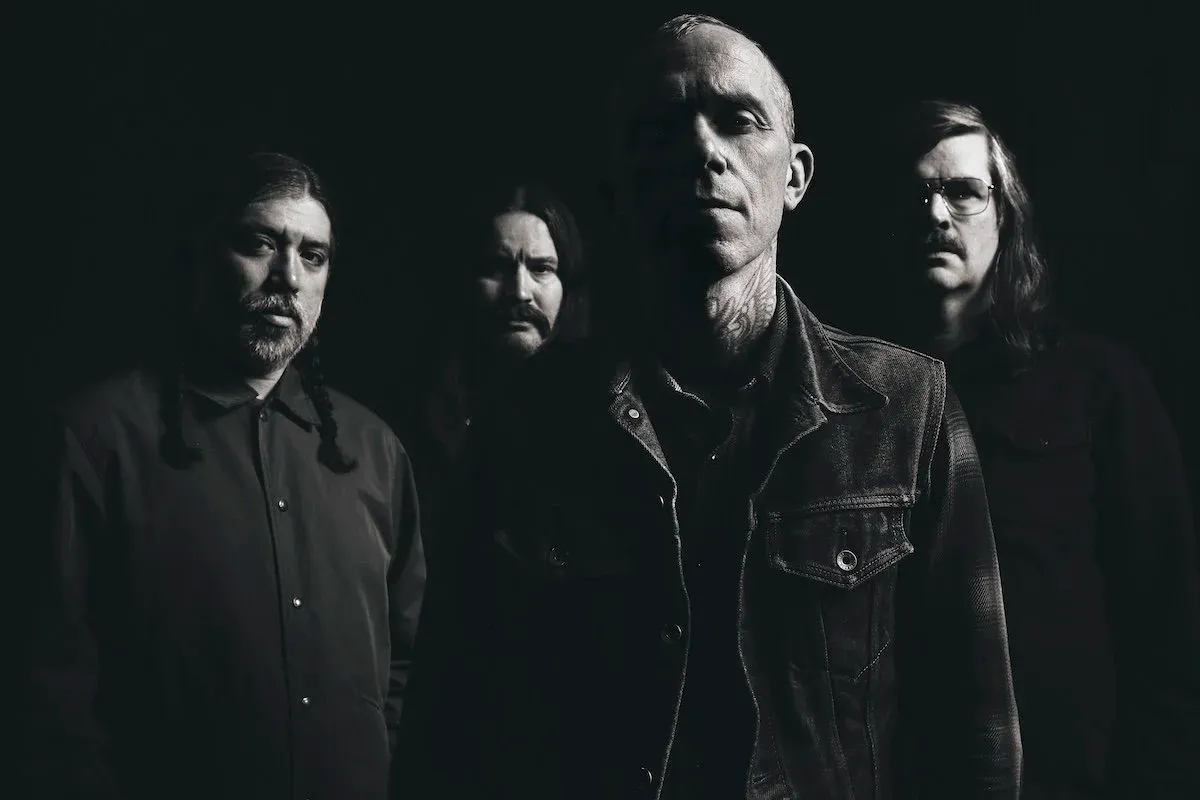
Converge’s vocalist Jacob Bannon opened up to The Note about the band’s new album, Love Is Not Enough, how his life impacts his writing and writing with Chelsea Wolfe.
Words Will Oakeshott // Image Jason Zucco
“We’re too punk for the hardcore kids. We’re too hardcore for the metal kids. We’re too weird for the punk kids. We don’t really get a typical audience. We challenge all those sub-genres.” – Jacob Bannon.
This excerpt from Jacob Bannon, the prolific frontman and lyricist of Salem’s math-metalcore luminaries Converge, tells the band’s complete story and flawlessly articulates their phenomenal musical distinction after all these years. This past Friday, February 13, the quartet released their 11th astounding album, Love Is Not Enough. The Note had the incredible honour of catching up with Jake, and this is what transpired.
“Art isn't a product. It's an experience.” – Lori Lansens.
This seven-word quote from Canadian novelist/screenwriter is actually found in her award-winning novel entitled The Girls. It is about Rose and Ruby Darlen, craniopagus conjoined twins who are joined at the skull. However, despite being twins, they’ve always striven to be different.
“…to be different.”
Indisputably, it is near impossible to place a “concept” on the musical pathbreakers of Salem’s math-metalcore act Converge. However, “to be different” does correspond to their incredible innovation. For over three decades, the four-piece have delightfully disturbed the archetype of heavy music, maturing and enrapturing in dissonant disorder with astonishing amalgamations of the music they loved. Hardcore, metal, punk, post-punk, new wave, thrash, metalcore and more – the subgenres synthesise into what could arguably be best described as one word: “Converge”.
Undeniably, their art is “an experience”.
“Thank you for that. For you know, taking that time to connect with that aspect of what we are, and what we're putting out into the world,” Jake Bannon expresses from a darkened room, dimly lit by mostly a computer screen, but still glowing radiantly with his breathtaking artwork featured in the background. “It's a double-edged sword, where it feels good to be able to share things with people, but it also hurts too, in the sense that these are songs which they're personal in nature. They're very much rooted in our everyday lives. There's no fantasy here.”
This “hurt” that is found throughout Love Is Not Enough, is it currently more imposing and momentous than the emotional poetry that was uncloaked on The Dusk In Us or All We Love We Leave Behind?
“When I'm working through things in my own life, I'm doing it through the art form itself. So just because the song is done, doesn't mean that that aspect of your life is sort of now compartmentalised and under control. You're still very much dealing with all of the things that brought me to the dance, to write the songs in the first place, you know? They're all still very much real things for me on a daily basis,” Bannon discloses with a reflective veracity, and after a moment of introspection, he continues, “So, I'm not there yet. I hope to be though, I definitely do. My goal as an artist is to not create something and just move on, but I want a positive psychological response for myself in that process, right? So, I'm just not fully there with this one yet. I'm still in the weeds.”
READ MORE: Better Lovers: Back To Square One After Two Decades
The arresting yet spectacular closing composition on Love Is Not Enough, which is entitled ‘We Were Never The Same’, describes an experience that countless humans encounter throughout their lives, the coming together of people for the departure of a loved one at a funeral. From this writer’s perspective, Bannon’s lyrical adaptation for this sorrowful event was at the superlative level of poetic greats, especially Ian Curtis (Joy Division).
“We mean nothing in our distance. We were never the same.”
These two sentences would potentially and superbly fit into the puzzle of Joy Division’s full-length Closer. Rhythmically and spiritually, it is powerfully parallel with ‘Atrocity Exhibition’ on multiple dimensions. For Jacob though, it enticed this scribe to ask him, was this enlightened narrative of a sorrowful ceremony one he had personally experienced, or was this more of an outsider’s interpretation?
“No, I mean, it's about my life and about my sort of reflections on what I was going through at that particular point in time. Since then, that feels like it was yesterday, because it really wasn't that far from today, you know? I don't think that aspect of my life; it certainly hasn’t resolved itself or improved itself in ways that I can say have drastically changed since that song was written, or that aspect of that song was written, you know? But I'm aware of it, and I'm working on it to the best of my ability. I think that's all I can sort of offer myself in the world in terms of dealing with something like this and in a responsible manner.”
In terms of writing ‘We Were Never The Same’, did you find that therapeutic considering the gravity of it all?
“Just because you make the art doesn't mean that all the other things sort of dissipate. They're still very much present and very much real, and making the art and music is an important step in and just being a better person, and just trying to do the thing.”
What about performing the songs live? Does that bring about some closure?
“It can, for sure, because it gives you a different sort of look at the material. If you're playing a song over and over again, eventually you kind of get to this point where you're emotionally still very attached to it, but you're not living it in that moment. You may be relating to it, and you may be emoting and sort of feeling it, but it could also become about something else in that moment. That's a thing that happens. I feel like, when that happens, that's probably when I know I've had some distance, enough distance to sort of free me a little bit from the process, if that makes sense?
Essentially, it comes down to interpretation. What Jacob Bannon pens in a Converge, or Wear Your Wounds, or an Umbrae Vitae song could be comprehended very differently from the observer’s contemplation.
“Art isn't a product. It's an experience.”
READ MORE: Lacuna Coil: Surviving 30 Years Of Technological Disruption
At this point in our conversation, Jake turned the tables and asked me a question: “When you listen to a band like ours, do you hear it as something which is a positive experience? An uplifting experience for you? Or is it something else?”
Having listened to Converge rather attentively since 2001’s Jane Doe, this was difficult. I do recall my first real “shining moment” of attachment came from their single ‘Eagles Become Vultures’ released in 2004 on their critically acclaimed You Fail Me LP. Its gloom-driven, frantic energy struck like repetitive explosions of thunderous noise to my entire being. Jacob’s cacophonous shriek escalated my soul towards a sense of freedom I had not experienced through heavy music before that moment. I explained to him that what I took away most from that charismatic clamour of math-metalcore discordance by Converge back then is that I didn’t want to be carrion for vultures, or the prey for eagles either. I wanted to escape from being hunted on numerous levels. I did find it essentially “uplifting” in its aggression.
“That’s interesting, because that take is kind of my goal, right? As the person writing the song, it's not going to be heard that way by most people, and that's okay, you know, but it's part of it. So, I'm always just kind of curious to know where it lands for people. Because as a person, I try to disconnect from the song once it's out in the world, because you can't control it, you'll go crazy if you want people to understand it the way that you felt it. You know? After the selfish experience of writing a song and putting it out to the world, after that, it's kind of no longer yours. You know?”
What about in collaboration projects, for example, the Bloodmoon:I LP with Chelsea Wolfe?
“We didn’t have that kind of experience with Chelsea, probably because we were building something together. It's just a different kind of experience. What I did find to be interesting about that was just writing for other people. Where I'm writing melodies and lyrics for, in the end, Chelsea and Steve (Brodsky, multi-instrumentalist/producer) that are well…. They're basically being played by, for lack of better terminology, virtuosos to me that have a different kind of superpower than my superpower.”
Did that alter your frame of mind in the sense of the poetic approach?
“So, that felt unique and exciting to do with Chelsea and with Steve, just from there, just writing for different people. It just feels different, you know? I can then also go the other way as well, they were bringing ideas to the table and bringing lyrics to the table. So, it wasn't a one sort of directional thing for us. We were all kind of in it, which was really exciting for all of us, because all of a sudden, the song becomes something so much greater than you could ever have thought it could be.”
Even for Jacob Bannon: “Art isn't a product. It's an experience.”
Converge’s Love Is Not Enough is out now via Epitaph Records. Listen here.
Get the best of The Note in your inbox.